


Slice Review:
Drinking and Driving, a film by Avalon Fast and Jillian Frank
By Toni-Marie Gallardo
Watched at the Los Angeles Festival of Movies
From the blur of handheld camera and sound of cooing doves over Bedroom Trap music, I emerged sanctified by the intimate meandering of Jillian Frank and Avalon Fast’s debut collaborative feature Drinking and Driving.
Compared to the creative drought of mainstream films today, Frank and Fast, as writers/directors/editors who follow desire rather than logic, structure or marketing trend, to quench our thirst. The result is a (potentially controversial) feminist film that is part mumblecore, part cinema verité, part music video. The effect is achieved by using a character/relationship-driven loose script with non-actors who, at times, directly address the audience (and throw a little a**). The pair also surprised me with their presence and subtlety as lead actors. It anchored the film as a film versus an experimental documentary or video art.
KISS ME I’M CONFUSED ~ The opening sequence (a driving shot that tracks Iris and Palmer from the middle backseat) immediately makes the audience a willing participant in the characters’ world. The film starts with quick cuts to a low-down, 3/4 shot looking up at Palmer like a child, right as she vomits Twisted Tea. We follow the girls to the race track to find Palmer’s mom, where the voices are drowned out by rowdy crowds and roaring engines, except for a few “Fuck You”’s from mom to daughter and vice versa. The pair arrive at Palmer’s grandma’s house, and in the blue glow of a cryptic TV error message, make out and play hide and seek.
However improvised the film may feel, which I would guess is sometimes by choice but also by force of necessity or a bit of novice, it is more than a straightforward portrait of the late-millennial twenty-somethings in their rural milieu. There is a spectral sense of time and place in the film’s plot and in the perspective of the viewer. However, this sense isn’t quite like the indie magical realism one might think of, like the fantasy escape of The Florida Project or Bird, or even fantastical world-building, such as in the work of Jane Schoenbrun (though I believe Fast and Schoenbrun share similar roots in horror taste). Nor is it fantastical in a self-aware and didactic way, like some of the queer new wave films of the 1990s. Drinking and Driving paves its own road.
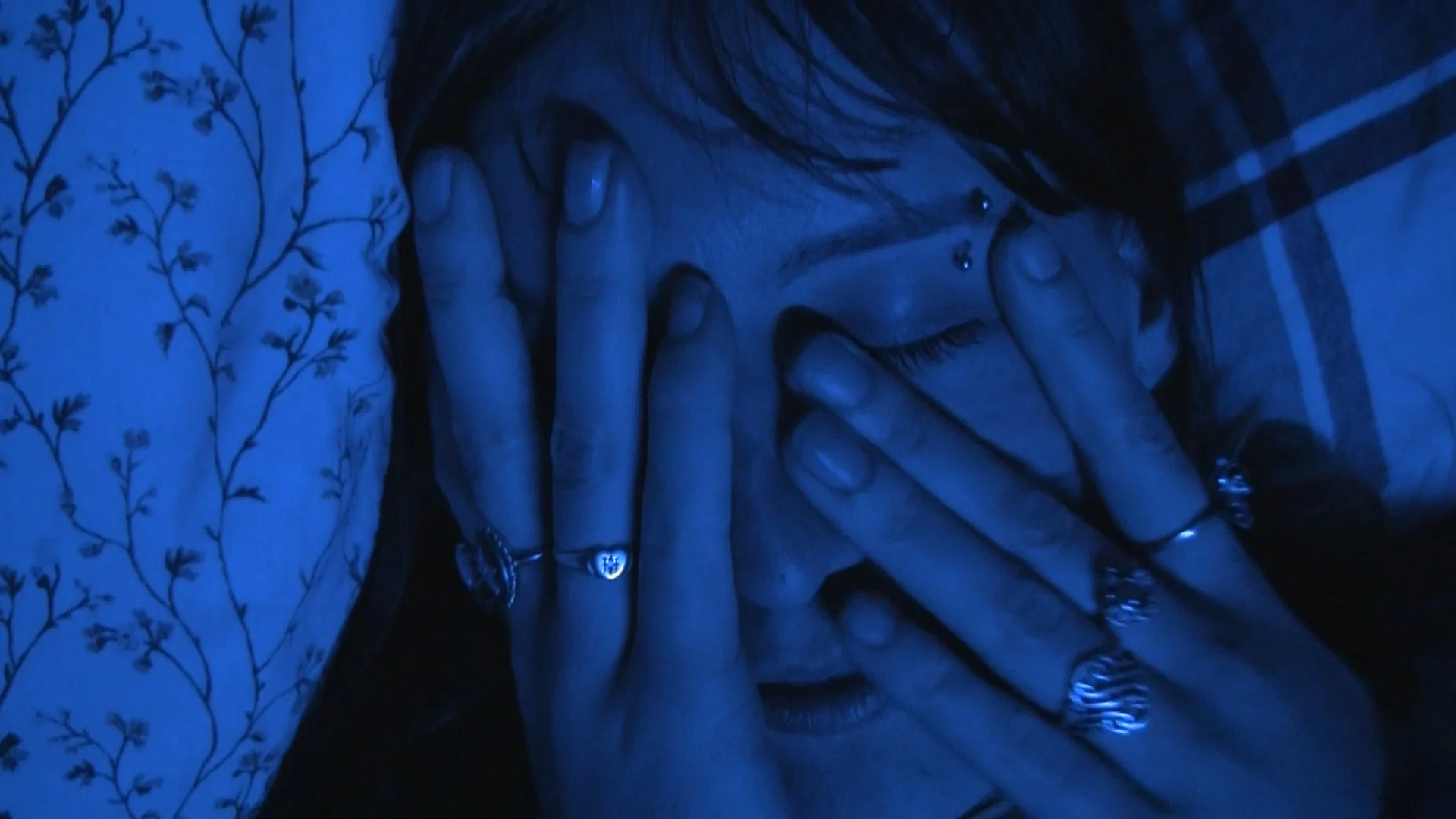
NO SIGNAL ~ To Palmer and Iris, time exists only to clock in and clock out of work. The camera continues to look up and out–looking for something, anything to give context to these women’s place in the world. Two drunken parties later, halfway through the film, the camera in a wide shot shows the women looking small against a mountainous background–a sense of distance we hadn’t felt before. After this moment, we finally learn that Iris is a mother to a two-year-old.
Even with its experimental way, there are several beautiful compositions in shots throughout which make it clear that the tight-knit crew behind Drinking and Driving has a deep respect for the history of the medium of film, albeit sometimes with a bit of novelty or overindulgent whimsy for my taste; there is a long lull in pacing somewhere around the second chapter, and I cannot get behind titled overlays (even in a sweet and delicate serif font) unless really baked into the storytelling device. But, the film takes place in 2016, so the chaotic, whimsical style feels resonant–2016 being the year that some culture writers have referred to as “the last Real Summer” (cue Lana Del Rey). The film is fascinatingly psychic in that way: though it is set distinctly in Vancouver, in 2016, it speaks to a particular ennui that goes on to haunt dominant culture for the next ten years. And, though perhaps unintentional, through its unique orchestration of disparate approaches, I feel the film has contributed something truly new to today’s independent cinema space.
THE DEATH DRIVE ~ Phoenix tells Levi about his mother's death. There is an interruption: a faceless Levi stumbling through the meadow with no clear direction. Then, eros becomes more desperate, and reality becomes psychologically torturous, nightmareish. Did Phoenix and his cousin Levi just kiss? Did Phoenix and Palmer just veer off the road? Cut to: In the field of confusion, under full sunlight, the four of them follow their instincts. Then, in that same frame, a faceless Levi is stumbling through the meadow with no clear direction. Levi walks into the forest alone.
Overall, the film’s genius doesn’t have to explain itself; instead, it lies in its youthful, unintentional wisdom and bold choices. Either you get it, or you don’t. Frank, Fast and company don’t really care. And I love it.
Published 4.24.26